
Flowers, flowers
...and more flowers

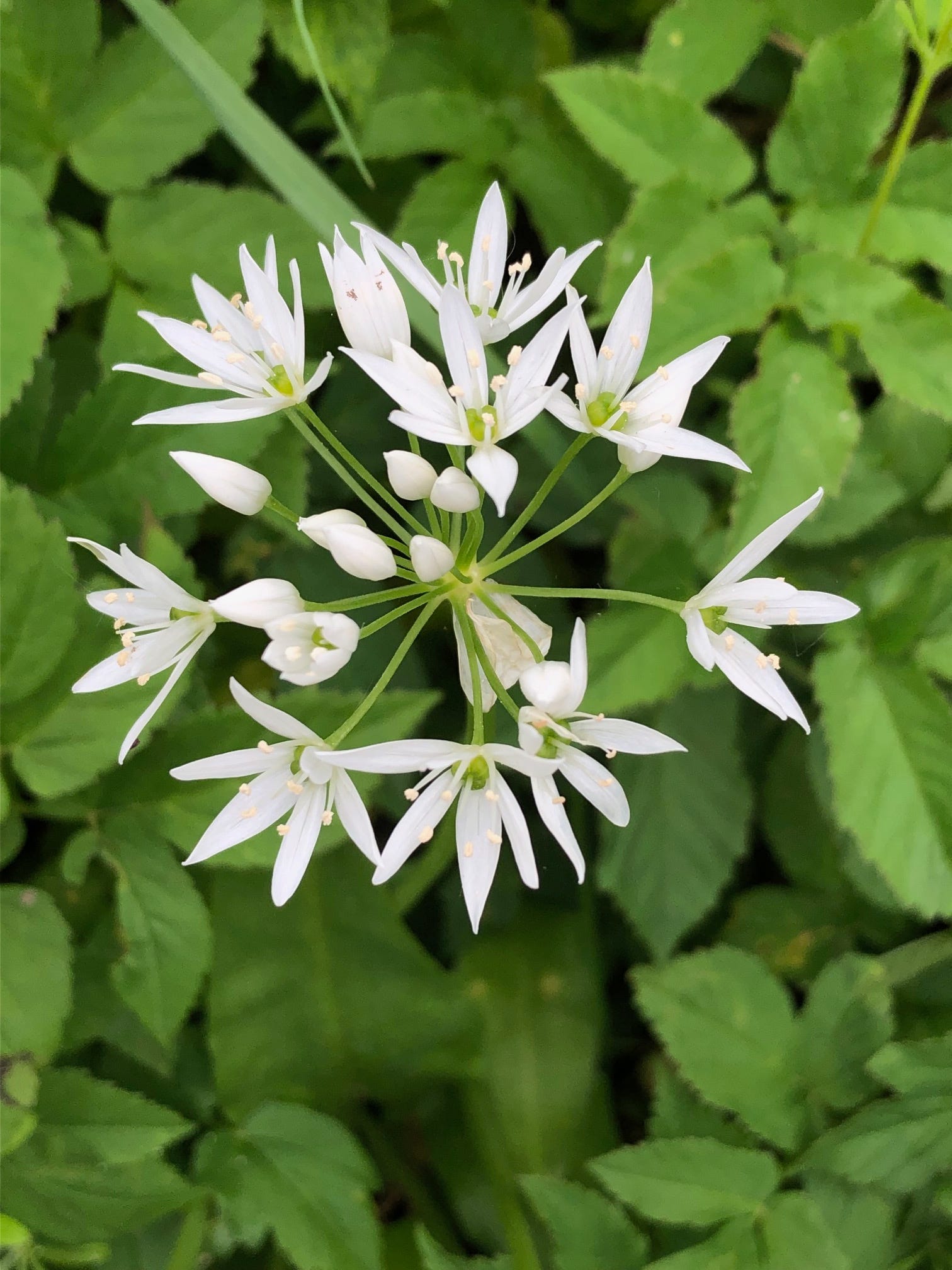
More from my Birch Sutra-in progress, prompted by a few weeks spent with David George Haskell’s brilliant How Flowers Made Our World – The Story of Nature’s Revolutionaries, listening to it as an audiobook alongside the world burgeoning before our eyes into lush abundance. Native to the UK, now transplanted to the US, Haskell writes about flowers growing all over the globe in many different habitats, dependent on diverse relationships. Although the book is loosely divided into plant families – magnolias, grasses, roses, orchids, tea, pansies – it is as much about ecology as botany, emphasising adaptation across time rather than quick fixes, pollinators more important than prizes.
You can’t help share his curiosity and delight on field and research trips – I learnt so much about all these astonishing flowers and their places, indigenous and human-imposed. As is usually the case with audiobooks I’ve enjoyed that are packed with fascinating detail, I know I’ll need a copy of the actual book to spend more time with and properly absorb all the information. It’s the sort of book I like having on my shelves to keep referring to as the seasons change and questions arise about particular flowers, their patterns and processes.
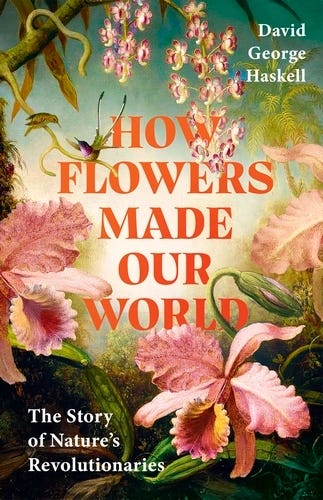
Haskell has written a piece (essay & audio) for Emergence Magazine to accompany the book, Wildflower Beauty and the Search for Home, focussing on the coming of Spring with intricate vignettes of snorklewort, columbine, daffodil and spring beauty: ‘To know the seasons, look to plants.’ He reminds us that the word ‘season’ comes, via the French saison, from the Latin, serere ‘to sow’, and charts the disruption of the interlocking rhythms of plants, trees, birds and insects by climate chaos.
And yet, despite it all the ‘carnival’ and ‘exuberance’ of Spring still occurs – ‘the nectar of reality… part of the antidote to algorithm-shaped lies. Celebrating wildflowers is not an anaesthetic – attentiveness reveals loss as well as beauty – but a grounding in the world as it is. Because flowers so entrance our senses, they offer memorable lessons, reorienting us back to the living Earth.’
The greening is happening so quickly just now, all manner of flowers appearing overnight in gardens and hedgerows – don’t let this beautiful time of year pass by without savouring it, paying attention to what is at risk and the way it is calling us into new, more rooted and real relationship. How better to spend May than tuning into the flowers springing up in your world, along with those you remember and carry inside you?
I hope you enjoy reading.
L
x
From Birch Sutra
233.
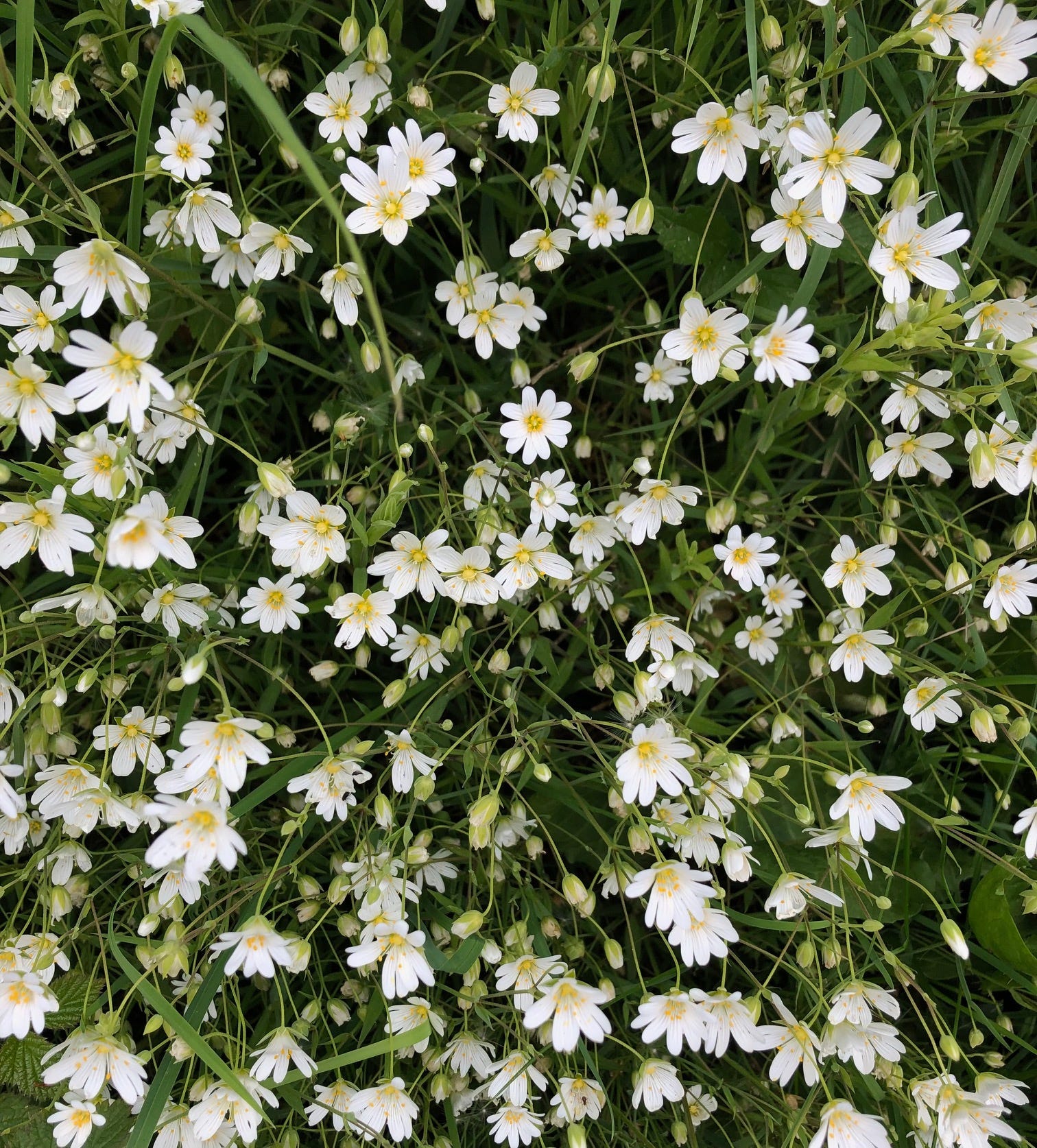
If words are shaped breath, flowers are shaped light. Making a home for myself and my children in the Northumberland countryside, I rediscovered the names of wild flowers I’d learned from my mother’s tea cards. Hardly able to contain my excitement whenever she opened a new packet, I’d slip my fingers between the green paper and the lining to fish out the surprise of a brand new flower. From these, I knew the shiny gold stars that grew down the lane in springtime were lesser celandine and the tall purple spires that exploded into curling white wisps were rosebay willowherb. I recognized others from C.F. Tunnicliffe’s earthy paintings, slightly blurred in reproduction: cowslip, tansy, angelica, ragged robin. I was already captivated by their names – the sound of them like snatches of song, a spell, the sort of sweetness you might call someone you loved. These flowers may have been printed on small rectangular pieces of card tucked inside packets of tea but somehow I recognised them. They were part of me and my story; a whispered invitation to explore one corner of the natural world that didn’t bite and mostly didn’t scratch, a world that didn’t run away and abandon you, but every year kept coming back. Flowers made no noise. There was no looming sense of trouble. I knew I could go to the place they whispered of because part of me was already there.
234.
Those nursery years sparked the connection in my mind between flowers in the wild and self-awareness, family, nourishment and healing. So many of the names are associated with mending and mothering. Some catch a sense of needle and thread, silk against skin – ragged robin, cowslip, stitchwort, foxglove, cotton grass, monkshood, skullcap. Another name for shepherd’s purse is mother’s hearts. Then, in the medicine cabinet, there’s feverfew, self-heal, fleabane, woundwort. Lady’s mantle is explicitly dedicated to the Virgin Mary; costmary to Mary Magdalene and all fallen women. As my children grew up, so did I. My father died before I was thirty, followed seven years later by my mother, and inevitably I came to understand change in a more visceral way. I saw the ineluctable wildness in the flowers and every year added new names to the list in my head from walking in unfamiliar terrain, finding a different species and looking it up or talking to friends. I’ve come to know hay rattle, stinking hellebore, butterbur and, on the coast, restharrow, sea rocket, frosted orache. The names grow wilder and wilder, like the creatures they’re often named after – viper’s bugloss, hogweed, yellow toadflax, monkey flower, bee orchis. This seems to let slip how irrepressible life is, the gentle flame of intimacy that can light up the darkness, the blossoming that can happen if you’re open to your senses and other people’s and the play of the elements: honeysuckle, nipplewort, cuckoopint.
235.
Some flower names sound to the ear like minimalist poems – forget-me-not, meadowsweet, speedwell, traveller’s joy, loosestrife, selfheal – small injunctions to live, to open, to be. Many are in the tradition of kennings, intense compounds of habit and habitat – snowdrop, frogbit, bindweed; two syllables of equal weight form spondees, metrical hinges between name and flower – bluebell and ragwort. Their tendrils curl through the leaves of literature, joining here to there in a way that confirms our sense of ourselves, helps us speed well, lose strife and heal ourselves. We have narcissus from the Greeks, the wild daffodil, that remembers death with its nodding golden trumpets; yarrow that reminds us every Achilles has his heel; Shakespeare’s mustardseed and peaseblossom, his rude mechanical flowers, as well as the more aristocratic, deranged, rosemary and rue. The names of the plants are as enchanting as their namesakes, triggering all their fragrant associations whenever they are written, read or spoken.
236.
I always told my children the names of wild flowers when we spotted them on our walks but, not inheriting my fascination with language, they were never very interested. They were interested in the elderflowers we made into ‘champagne’ every July, the wild garlic we chopped into pizzas, flans and sandwiches, the nettles cooked into a soup that didn’t sting their lips. They made their own strange cocktails out of pineapple weed, sorrel and dandelion. These edible plants are the ones that took root. Both my sons, now grown and taller than I am, love to cook, and earn their living in busy kitchens. So, time passes and it’s marked in the ‘common’ names of dandelion clocks, bellflowers, the Lenten lily and Jack-go-to-bed-at-noon. I see the passing of my own life in their image, reminding me who I am, where I’ve been, what I need – and how short a time we have. Like the birch trees, each flower is a little book you can read, petal by petal, a small heaven you can lose yourself in, then find yourself over and over again.